

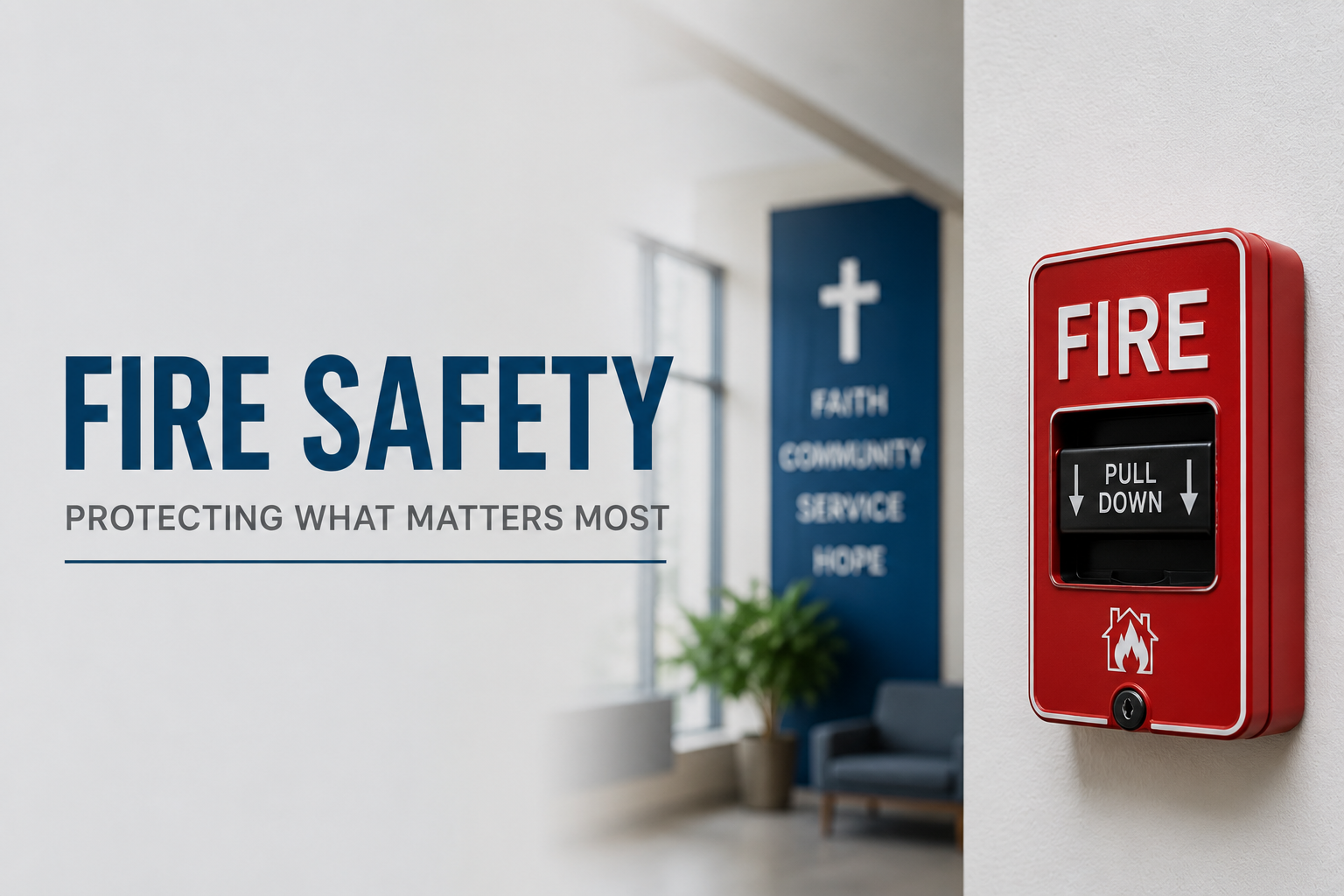
I researched this against U.S. Fire Administration, OSHA, and NFPA sources so the statistics are supportable. I also kept the tone educational rather than overly sales-focused, with the Back to Business campaign carrying the theme.
Back to Business: Why Fire Safety Should Be a Priority for Your Nonprofit or Church
As organizations settle back into their regular routines, “back to business” means more than reopening calendars, planning programs, and welcoming people through the doors.
For nonprofits and churches, it also means making sure the building where your mission happens is ready to safely support the people who depend on it.
Staff members are returning to offices. Volunteers are preparing programs. Churches are holding services, classes, meetings, and community events. Nonprofits are serving clients and hosting visitors. Kitchens are being used, storage rooms are filling up, and facilities may be busier than they have been in months.
With all that activity, now is an important time to ask a simple question:
Is your facility prepared for a fire emergency?
Fire safety can easily become another item on a long facilities checklist. But an effective fire protection strategy does more than help protect a building. It helps protect your people, your property, and your ability to continue serving your community.
The Numbers Show Why Fire Safety Matters
Commercial and community facilities are not immune to fires.
According to the U.S. Fire Administration (USFA), there were an estimated 110,000 nonresidential building fires in the United States in 2023. Those fires resulted in approximately 130 deaths, 1,200 injuries, and more than $3.16 billion in property losses. From 2014 through 2023, the estimated number of nonresidential building fires increased by 19%. (U.S. Fire Administration)
Places of worship face their own risks.
NFPA data incorporated into its cultural-resource fire protection materials indicates that from 2017–2021, cultural resource properties experienced an estimated annual average of 1,740 fires and $63 million in property damage. Approximately 92% of those fires occurred in religious and funeral properties. (NFPA Doc Info Files)
Those statistics are an important reminder: fire safety isn't something organizations should think about only after an incident occurs.
It should be part of doing business.
1. Your Building Is Getting Busy Again
Churches and nonprofits often have a unique mix of people moving through their facilities.
On any given day, your building might include:
- Employees
- Volunteers
- Children
- Seniors
- Visitors
- Vendors and contractors
- Community groups
- People with disabilities or mobility limitations
And the way the building is used can change throughout the week.
A church sanctuary may be relatively empty Monday morning and packed on Sunday. A fellowship hall might become an event space. A nonprofit conference room may host a training session with dozens of visitors.
That makes emergency planning particularly important.
OSHA guidance recommends establishing clear evacuation procedures and routes, accounting for people after an evacuation, identifying assembly locations, and planning for visitors and individuals who may require additional assistance. (OSHA)
As you get back to business, consider whether your emergency procedures still match how your building is actually being used today.
2. Your Fire Alarm System Needs to Be Ready Before You Need It
Most of the time, your fire alarm system stays quietly in the background.
That is exactly where you want it—until there is an emergency.
Fire alarm and detection systems are designed to help identify a potential emergency and alert building occupants so they can respond. But simply having equipment installed doesn't mean it should be forgotten.
Inspection, testing, and maintenance are essential parts of keeping fire protection systems ready.
NFPA's fire alarm and signaling requirements include periodic testing of system components. For example, NFPA materials addressing fire alarm testing call for annual functional testing of system smoke detectors in nonresidential applications to verify smoke can enter the sensing chamber and initiate the appropriate response. (NFPA Doc Info Files)
Testing can help uncover issues that may otherwise go unnoticed—such as problems with detection devices, notification appliances, backup power, system communications, or other components.
The best time to discover a problem with a fire alarm system is during an inspection—not during an emergency.
3. Everyday Activities Can Create Real Fire Risks
Not every fire begins with an unusual event.
Sometimes the risk comes from everyday operations.
The USFA reports that cooking was the leading cause of nonresidential building fires from 2014 through 2023. In 2023 alone, an estimated 33,300 nonresidential building fires were cooking-related. (U.S. Fire Administration)
That's particularly relevant for churches, community centers, shelters, food pantries, and nonprofits with kitchens or food-service operations.
Electrical problems are another concern. In 2023, the USFA estimated 7,400 nonresidential building fires caused by electrical malfunctions, resulting in approximately $354.4 million in property losses. (U.S. Fire Administration)
Other hazards can be surprisingly ordinary: equipment, stored combustible materials, overloaded electrical systems, damaged cords, blocked exits, or changes to a space that affect how people evacuate.
Fire prevention isn't only about preparing for the extraordinary. It's also about paying attention to the ordinary.
4. Technology Is Only Part of Your Fire Safety Plan
A functioning fire alarm system is important, but technology cannot replace preparation.
Your people need to know what happens next.
For workplaces required to maintain an Emergency Action Plan, OSHA identifies several fundamental elements, including:
- Procedures for reporting a fire or other emergency
- Emergency evacuation procedures and exit route assignments
- Procedures for accounting for employees after evacuation
- Identifying employees responsible for particular emergency duties
- Training designated employees to help with a safe and orderly evacuation (OSHA)
OSHA also recommends considering how visitors will be evacuated and accounted for and how employees or visitors with disabilities may receive assistance. (OSHA)
That last point is especially important for churches and nonprofits.
Your employees may understand the building, but the visitor attending an event for the first time probably doesn't. A volunteer may not know the same procedures as a staff member. Children, seniors, or people with mobility limitations may need additional assistance.
A strong fire safety plan connects systems, procedures, and people.
5. Protecting Your Building Helps Protect Your Mission
For a nonprofit or church, a building is rarely just a building.
It's where meals are prepared.
It's where families receive assistance.
It's where children learn.
It's where volunteers give their time.
It's where people worship, gather, celebrate, grieve, and find community.
It's also where organizations keep technology, records, supplies, equipment, and other resources that may have taken years to build.
The financial consequences of a fire can be substantial. In 2023, USFA estimates show more than $3.16 billion in total losses from nonresidential building fires. Unintentional or careless fires alone accounted for approximately $881.2 million in losses, while electrical malfunction fires accounted for another $354.4 million. (U.S. Fire Administration)
For a mission-driven organization, however, the impact can't always be measured in dollars.
A serious fire can interrupt programs, displace staff, cancel services, destroy important resources, and prevent an organization from serving the people who count on it.
That makes fire protection part of something bigger: continuity of your mission.
Your Back-to-Business Fire Safety Checklist
As your organization gets back into its regular rhythm, take a few minutes to walk through your facility and ask:
- When was our fire alarm system last professionally inspected and tested?
- Are exits and evacuation routes clearly marked and unobstructed?
- Do employees and volunteers know what to do when the fire alarm activates?
- Do we have an established evacuation assembly location?
- Do we have a way to account for employees, volunteers, and visitors after an evacuation?
- Have we considered people who may require additional assistance during an emergency?
- Are fire extinguishers and other fire protection equipment accessible and properly maintained?
- Are kitchens, storage rooms, electrical areas, and other higher-risk spaces being kept safe?
- Have we renovated, expanded, or changed how any part of our building is used?
- Has our occupancy increased since our fire protection system was originally designed or last evaluated?
- Are inspection, testing, and maintenance records current?
If you're unsure about several of those answers, that's a good indication it's time to take a closer look.
Get Back to Business With Confidence
Getting back to business isn't only about what your organization plans to accomplish next.
It's about making sure you're prepared to accomplish it safely.
Your fire alarm and life safety systems play an important role in protecting the employees, volunteers, visitors, property, and resources behind your mission. Regular inspections, testing, maintenance, and a well-understood emergency plan can help make sure your organization is prepared before an emergency happens.
At Knine All Systems, we help organizations take a proactive approach to fire and life safety through professional fire alarm solutions, inspections, testing, service, and system support.
As your nonprofit or church gets back to business, make fire safety part of the plan.
Contact Knine All Systems to schedule a fire alarm inspection or discuss whether your current fire protection system is keeping up with the needs of your facility.
Sources
U.S. Fire Administration (FEMA) — Nonresidential Fire Estimate Summaries, 2014–2023
National estimates for nonresidential fires, deaths, injuries, property losses, and 10-year trends. (U.S. Fire Administration)
U.S. Fire Administration: Nonresidential Fire Estimates
U.S. Fire Administration (FEMA) — Nonresidential Building Fire Causes, 2014–2023
National data regarding leading causes of nonresidential building fires, including cooking and intentional fires. (U.S. Fire Administration)
USFA: Nonresidential Building Fire Causes
U.S. Fire Administration (FEMA) — Nonresidential Building Cooking Fire Trends, 2014–2023
National estimates and trends for cooking-related fires in nonresidential buildings. (U.S. Fire Administration)
USFA: Cooking Fire Trends
U.S. Fire Administration (FEMA) — Nonresidential Building Electrical Malfunction Fire Trends, 2014–2023
National estimates for electrical malfunction fires and associated property losses. (U.S. Fire Administration)
USFA: Electrical Malfunction Fire Trends
U.S. Fire Administration (FEMA) — Nonresidential Building Fire Dollar-Loss Causes, 2014–2023
National estimates of property losses by cause. (U.S. Fire Administration)
USFA: Fire Dollar-Loss Causes
Occupational Safety and Health Administration — Emergency Action Plans, 29 CFR 1910.38
Requirements addressing emergency reporting, evacuation, employee accountability, alarm systems, training, and plan review. (OSHA)
OSHA: Emergency Action Plans
Occupational Safety and Health Administration — Evacuation Plans and Procedures
Guidance regarding evacuation routes, visitors, employees with disabilities, assembly locations, and employee accountability. (OSHA)
OSHA: Evacuation Plans and Procedures
National Fire Protection Association — NFPA 909 Supporting Fire Experience Data
NFPA materials containing fire experience statistics for cultural resource properties, including religious and funeral properties, for 2017–2021. (NFPA Doc Info Files)
National Fire Protection Association — NFPA 72 Technical Materials
NFPA technical materials addressing periodic inspection and functional testing of fire alarm and signaling system components. (NFPA Doc Info Files)
01
Faster Investigations
Modern security platforms help teams locate footage faster, identify vehicles and persons of interest, and gather evidence more efficiently.
Faster investigations
Improved evidence collection
Reduced response times
02
Streamlined Facility Access
Centralized access control helps organizations manage credentials, permissions, and facility access from a single platform.
Simplified administration
Better visibility
Improved accountability
03
Multi-Site Operations
Managing multiple locations becomes easier when security systems are unified into a single dashboard.
Unified visibility
Reduced complexity
Greater operational efficiency
04
Remote Monitoring
Remote facilities often lack on-site personnel. Remote monitoring improves awareness and response capabilities across distributed locations.
Increased visibility
Faster response
Enhanced coverage
Related Articles
.png)

Facility Snapshot
What does security look like at your location?
Claim your real-time area statistics and tailored security recommendations.
Get My Facility Snapshot >


.svg)
