

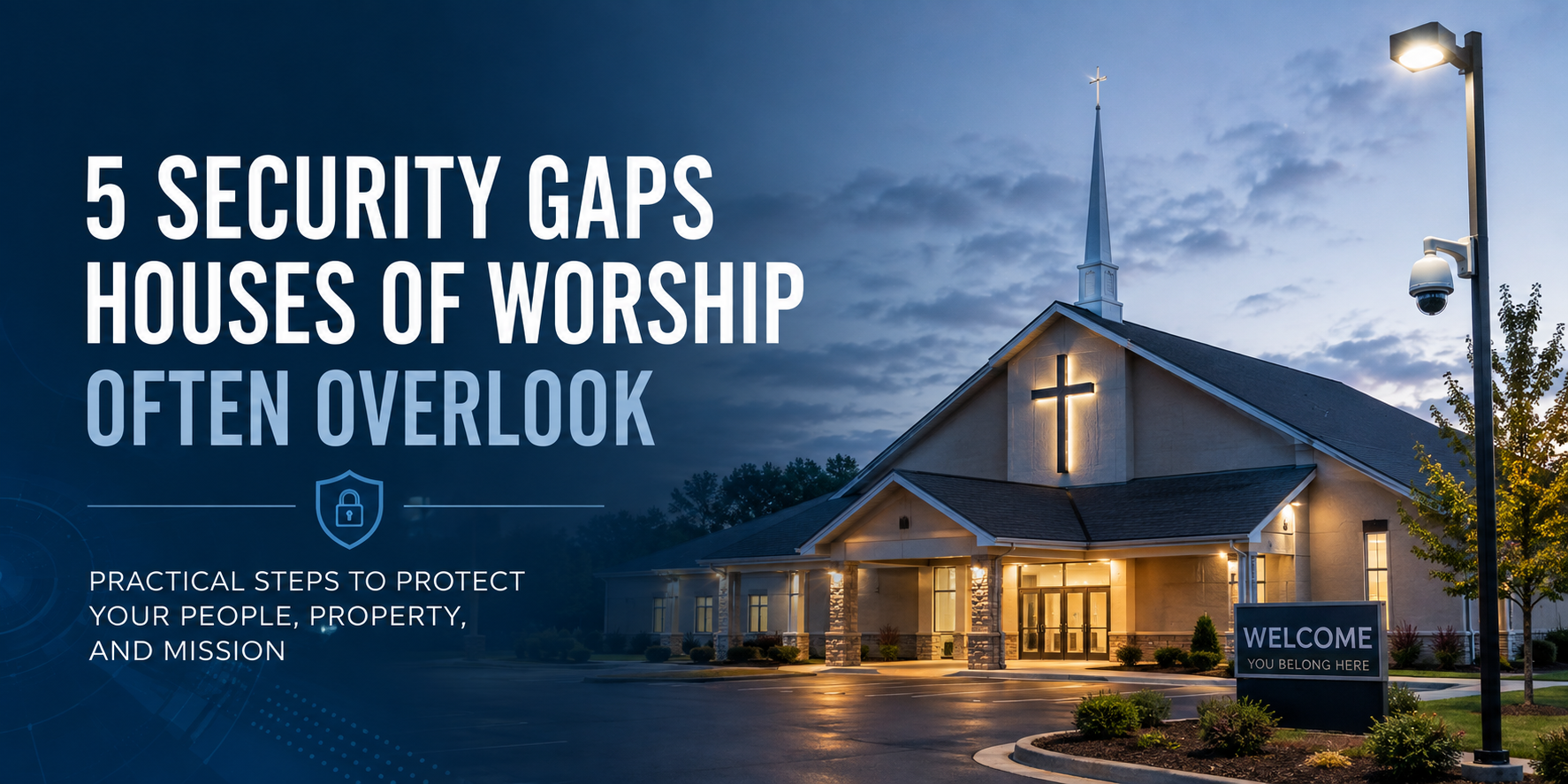
5 Security Gaps Houses of Worship Often Overlook
Churches and other houses of worship face a unique security challenge.
They’re designed to be open and welcoming. Throughout any given week, hundreds of people may move through the property for worship services, childcare, meetings, community programs, and special events.
But that openness can also create security gaps.
A side door left unlocked. A parking lot camera that can’t see clearly after dark. A visitor entering a children’s area without being noticed.
Individually, these issues may seem small. Together, they can create vulnerabilities that organizations don’t recognize until something happens.
The good news? Many of these gaps can be identified before they become incidents.
1. Parking Lots and Exterior Areas
Security doesn’t begin at the front door.
Parking lots can be particularly challenging for houses of worship because large properties may sit mostly empty throughout the week and overnight.
That can create opportunities for trespassing, vandalism, reckless driving, theft, and other unwanted activity.
The FBI has specifically noted the importance of considering areas beyond the main sanctuary—including parking lots, classrooms, nurseries, fellowship halls, and activity buildings—when developing a security plan.
Good exterior lighting, strategically placed cameras, low-light video coverage, and license plate recognition can help organizations better understand what’s happening across their property—even when nobody is there.
Ask yourself: Could you clearly identify a person or vehicle in your parking lot at 2 a.m.?
2. Doors That Aren’t as Secure as You Think
During Sunday services, open doors are part of creating a welcoming environment.
At 9 p.m. on a Tuesday, they’re a different story.
Volunteers may prop doors open while carrying supplies. Someone leaving an evening meeting may assume another person will lock up. Former employees or volunteers may still have keys.
The challenge is that leadership may not discover the problem until the next morning.
Modern access control and intrusion systems can provide alerts when doors are left open, propped, or accessed after hours. They can also make it easier to control who has access without distributing physical keys throughout the organization.
Ask yourself: If someone left a side door open tonight, would anyone know?
3. Children’s Areas Need Another Layer of Protection
Many houses of worship operate nurseries, daycare programs, preschools, religious education programs, or children’s ministries.
These areas deserve additional consideration.
CISA specifically recommends including affiliated childcare, schools, and youth programs when developing security plans for houses of worship.
Visitor management can help staff understand who is entering the building, while access control can limit entry into sensitive areas. Video surveillance can provide additional visibility around entrances, hallways, and common spaces.
Newer systems can also make it easier to locate a person across recorded video or alert designated personnel when specific activity requires attention.
Technology doesn’t replace good policies or supervision. It provides another layer of awareness.
Ask yourself: How easily could an unfamiliar visitor reach your children’s ministry areas?
4. Having Cameras Doesn't Mean Having Coverage
One of the most common security misconceptions is simple:
“We have cameras, so we're covered.”
Not necessarily.
A camera may show that someone entered the property without capturing enough detail to identify them. Exterior cameras may perform well during the day but poorly at night. Older systems can also make finding footage after an incident unnecessarily difficult.
The goal shouldn't be to install cameras everywhere.
It should be to make sure the cameras you have answer useful questions when something happens.
Who was there? Where did they go? What vehicle were they driving? What happened before and after the incident?
Ask yourself: If something happened tonight, how quickly could you find clear, useful footage tomorrow morning?
5. Technology Isn't an Emergency Plan
Cameras, alarms, access control, and other security technologies are valuable tools.
But they can't replace preparation.
CISA recommends that houses of worship develop and practice emergency plans, while the FBI emphasizes planning around the unique characteristics of each facility.
Employees and volunteers should understand who makes decisions during an emergency, who contacts first responders, how occupants will be notified, and what actions they are expected to take.
A small church with one building will have different needs than a religious organization operating multiple campuses, schools, or childcare programs.
There is no one-size-fits-all security plan.
Ask yourself: If an emergency happened during your next service, would your staff and volunteers know exactly what to do?
Security Without Losing the Welcome
Improving security doesn't mean turning a house of worship into a fortress.
It means understanding where vulnerabilities exist and making thoughtful improvements that protect people without changing the character of the organization.
Sometimes that means better technology.
Other times, it may be as simple as adjusting a camera, changing how doors are managed, improving exterior lighting, reviewing access permissions, or practicing an emergency plan.
The important part is finding those gaps before an incident does.
How Secure Is Your Facility?
At Knine All Systems, we help organizations evaluate their physical security and identify opportunities to better protect their people, property, and operations.
Our complimentary Security Snapshot provides property-specific insights that can help houses of worship better understand potential vulnerabilities and make more informed security decisions.
Start your complimentary Security Snapshot:
https://snapshot.k9allsystems.com/
Because creating a safer place to gather doesn't mean making it less welcoming.
It means being prepared to protect the people who walk through your doors.
Sources
Cybersecurity and Infrastructure Security Agency (CISA). Mitigating Attacks on Houses of Worship Security Guide.
https://www.cisa.gov/resources-tools/resources/mitigating-attacks-houses-worship-security-guide
Cybersecurity and Infrastructure Security Agency (CISA). Houses of Worship Security Self-Assessment and User Guide.
https://www.cisa.gov/resources-tools/resources/paper-based-houses-worship-security-self-assessment-and-user-guide
Federal Bureau of Investigation (FBI), Law Enforcement Bulletin. Police Practice: Helping Churches Feel Safe.
https://leb.fbi.gov/articles/additional-articles/police-practice-helping-churches-feel-safe-
Coram AI. Church Security: A Guide to Protecting Your Congregation.
https://www.coram.ai/post/church-security
01
Faster Investigations
Modern security platforms help teams locate footage faster, identify vehicles and persons of interest, and gather evidence more efficiently.
Faster investigations
Improved evidence collection
Reduced response times
02
Streamlined Facility Access
Centralized access control helps organizations manage credentials, permissions, and facility access from a single platform.
Simplified administration
Better visibility
Improved accountability
03
Multi-Site Operations
Managing multiple locations becomes easier when security systems are unified into a single dashboard.
Unified visibility
Reduced complexity
Greater operational efficiency
04
Remote Monitoring
Remote facilities often lack on-site personnel. Remote monitoring improves awareness and response capabilities across distributed locations.
Increased visibility
Faster response
Enhanced coverage
Related Articles
.png)

Facility Snapshot
What does security look like at your location?
Claim your real-time area statistics and tailored security recommendations.
Get My Facility Snapshot >


.svg)
