

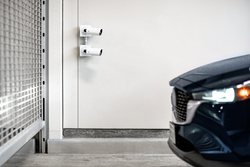
If you've followed the news recently, you've probably noticed one security technology getting a lot of attention: license plate recognition.
What was once primarily used by law enforcement is now being adopted by businesses, schools, apartment communities, and municipalities across the country. As security threats evolve, more organizations are looking for ways to gain better visibility into who—and what—is entering their property.
So, what exactly is Automated License Plate Recognition (ALPR), and why has it become one of the fastest-growing technologies in commercial security?
What Is ALPR?
Automated License Plate Recognition (ALPR) uses specialized cameras, optical character recognition (OCR), and artificial intelligence to automatically capture and identify license plates as vehicles pass by.
In addition to reading the plate number, many modern systems can also identify:
- Vehicle make and model
- Vehicle color
- Date and time
- Direction of travel
- Camera location
That information becomes searchable, allowing security teams or law enforcement to quickly locate vehicles connected to an incident instead of manually reviewing hours of video footage. According to the Congressional Research Service, ALPR is now widely used by larger law enforcement agencies because of its ability to quickly identify vehicles involved in investigations.
Why Businesses Are Paying Attention
Businesses are facing increasing pressure to improve security while doing more with fewer resources.
According to the National Retail Federation, retailers lost more than $112 billion to inventory shrink in 2022, with organized retail crime continuing to rise. As a result, many organizations are investing in technologies that help them investigate incidents faster and strengthen overall situational awareness.
For properties with large parking lots, multiple entrances, or heavy vehicle traffic, ALPR adds another valuable layer of information.
Where ALPR Makes the Biggest Impact
License plate recognition is no longer limited to police departments.
Today it's being used by:
- Distribution centers tracking delivery vehicles
- Apartment communities monitoring entrances
- Schools and universities improving campus awareness
- Manufacturers securing loading docks
- Commercial office parks and retail centers documenting vehicle activity
For many organizations, simply knowing which vehicles entered a property—and when—can significantly reduce investigation time after an incident.
What ALPR Doesn't Replace
One of the biggest misconceptions about license plate recognition is that it's a replacement for traditional security cameras.
It isn't.
ALPR tells you which vehicle was on your property.
Traditional surveillance shows what happened.
Access control tells you who entered the building.
Intrusion detection alerts you to unauthorized access after hours.
Each technology serves a different purpose, which is why the strongest security strategies combine multiple systems rather than relying on just one.
The Bottom Line
License plate recognition has earned its place as one of the most valuable tools in modern physical security. It helps organizations gather better information, investigate incidents more efficiently, and improve overall awareness of what's happening on their property.
01
Faster Investigations
Modern security platforms help teams locate footage faster, identify vehicles and persons of interest, and gather evidence more efficiently.
Faster investigations
Improved evidence collection
Reduced response times
02
Streamlined Facility Access
Centralized access control helps organizations manage credentials, permissions, and facility access from a single platform.
Simplified administration
Better visibility
Improved accountability
03
Multi-Site Operations
Managing multiple locations becomes easier when security systems are unified into a single dashboard.
Unified visibility
Reduced complexity
Greater operational efficiency
04
Remote Monitoring
Remote facilities often lack on-site personnel. Remote monitoring improves awareness and response capabilities across distributed locations.
Increased visibility
Faster response
Enhanced coverage
Related Articles
.png)


Facility Snapshot
What does security look like at your location?
Claim your real-time area statistics and tailored security recommendations.
Get My Facility Snapshot >


.svg)
